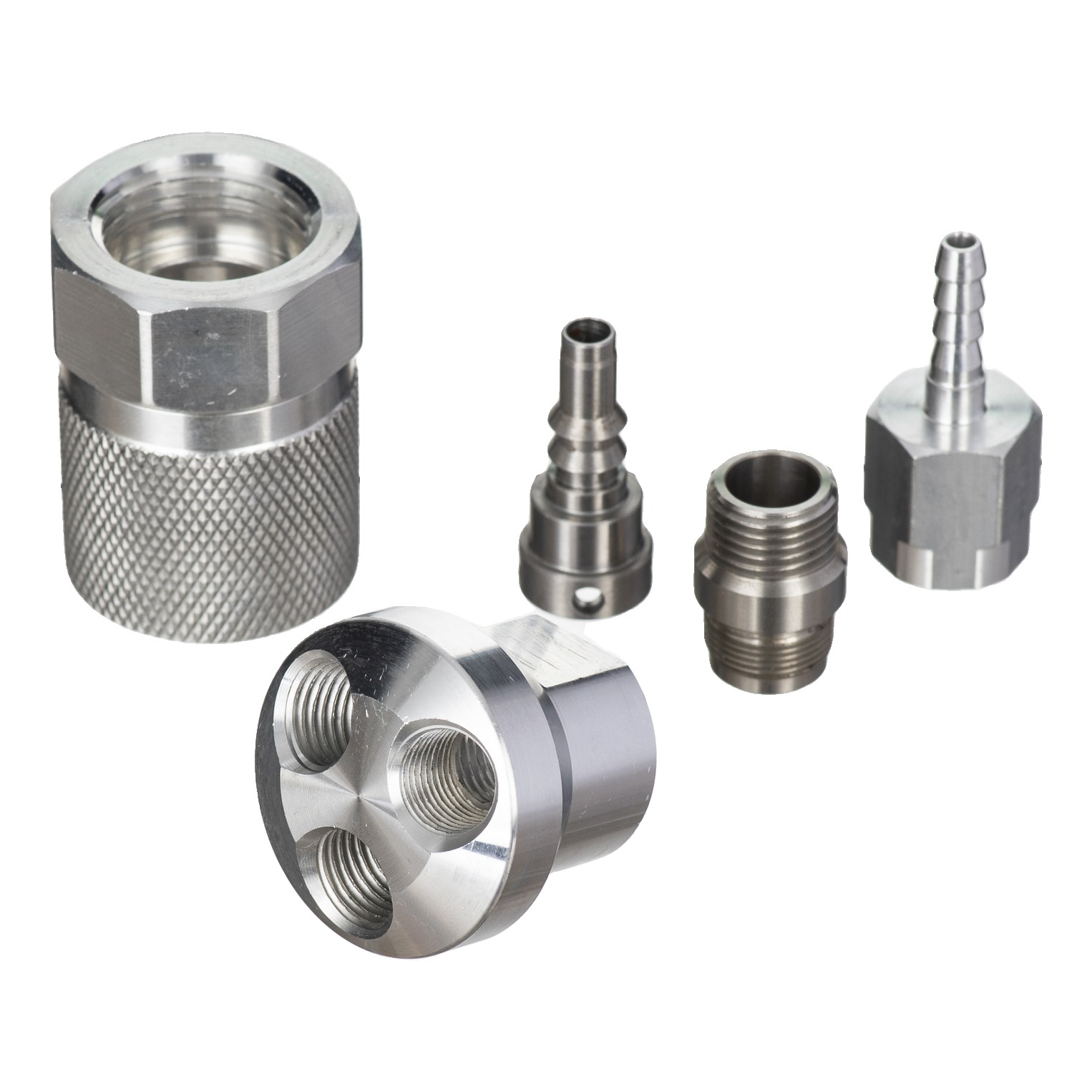
At JIAJIE we machine quick couplers and stainless steel fittings in brass, nickel-plated brass, SS304 and SS316. The single most common material question from distributors and OEM buyers is simply "which one do I need?" This guide gives you a field-deployable way to decide — without over-specifying (and overspending) or under-specifying (and replacing fittings in a year).
How the two materials actually behave
Both brass and stainless are alloys, and both machine well, seal well and carry air pressure safely at the ratings we publish. The difference is what happens to them over time in a hostile environment — and that is where the cost of a wrong choice shows up.
- Brass is copper + zinc. It is easy to machine, naturally antimicrobial-ish on the surface, and soft enough to seat a seal gently. Its weakness is dezincification: in the presence of moisture, salts or certain chemicals, the zinc leaches out, leaving a weak, porous copper skeleton that cracks under pressure.
- Stainless steel (300-series) forms a chromium-oxide passive layer that self-heals and resists corrosion. It is harder to machine (so a bit more costly) but shrugs off humidity, salt and most chemicals. SS316 adds molybdenum for chloride resistance.
Corrosion: the #1 reason to upgrade
Dezincification is the silent killer of brass pneumatic fittings. It does not announce itself — a fitting looks fine on the outside and then suddenly weeps or fails. The environments that trigger it:
- Coastal / marine air (salt-laden humidity)
- Outdoor year-round exposure
- Washdown areas (food, pharma, agriculture)
- Chemical or solvent exposure
- Any line that carries moisture or condensation regularly
If any of those describe your install, choose stainless. For a dry, heated indoor shop, brass is fine and the cheaper, sensible pick.
Pressure, temperature and media
Both materials handle typical shop-air pressure comfortably. The deciding factors are temperature and media:
- Compressed air (dry): brass or stainless both fine.
- Moist / oily air: stainless preferred if it also sits in a damp environment; otherwise brass is acceptable.
- Water / liquid transfer: use stainless or a fluid-rated fitting specified for the medium — never assume an air coupler is liquid-rated.
- Food / beverage / pharma air paths: stainless (316 common), and confirm the material certificate with your supplier. Brass lead-content makes it a poor choice for direct food contact.
- Chemicals / solvents: 316 stainless, verified against the specific chemical.
Cost and machinability
Stainless costs more per piece — higher raw-material cost and slower CNC machining. But weigh that against the cost of failure: a brass fitting that dezincifies in a coastal plant forces a line shutdown, emergency freight and labour. On a per-installation basis, specifying stainless up front is almost always cheaper than one premature failure. For high-volume, dry-indoor, price-sensitive lines, brass keeps the BOM where it should be.
Decision table: match the environment to the material
| Environment / service | Recommended material | Why |
|---|---|---|
| Dry indoor shop air | Brass (or nickel-plated brass) | Cost-effective, seals well, no corrosion driver |
| Humid but indoor (no salt) | Nickel-plated brass or SS304 | Extra barrier against surface corrosion |
| Outdoor / unheated | SS304 | Resists weathering and condensation |
| Coastal / marine / salt spray | SS316 | Molybdenum resists chlorides |
| Food / pharma / washdown | SS316 (+ cert) | Corrosion + cleanability + food contact |
| Chemical / solvent lines | SS316 (verify medium) | Broad chemical resistance |
Where 316, SS304 and nickel-plated brass each belong
- Nickel-plated brass — a middle option for humid indoor use: the nickel layer slows surface corrosion at modest extra cost versus plain brass.
- SS304 — the general stainless workhorse: outdoor, damp, mildly corrosive and most washdown-adjacent duty.
- SS316 — specify when chlorides are present: ports, coastal plants, marine equipment, food and chemical processing. If in doubt between 304 and 316 in a corrosive setting, 316 is the safe call.
Our material options at JIAJIE
We offer the same fitting profiles across materials so you can standardise the geometry and vary the alloy by duty:
- Quick couplers & plugs — brass, nickel-plated brass, SS304 and SS316 in Euro, ISO 6150B and ARO profiles.
- Stainless precision fittings — SS304 knurled sockets, ARO-style plugs, hose barbs, hex nipples and triple manifolds, CNC-machined to drawing.
- Material documents — RoHS / REACH certificates and dimensional inspection reports available on request; CE / ISO 9001 documentation can be arranged per order. We state exactly which document ships with your batch.
Send us your duty description (environment, media, pressure) and we will recommend the grade — no over-spec, no under-spec. Prefer to browse first? See our stainless steel fitting range or the full coupler catalog.
Frequently asked questions
Is brass good enough for pneumatic fittings?
For dry, indoor, compressed-air service brass is the cost-effective default and performs reliably for years. The problem starts in damp, coastal, washdown, chemical or food environments, where brass can dezincify — the zinc leaches out, leaving a porous, weak copper skeleton that eventually cracks and leaks.
What is the difference between SS304 and 316 stainless fittings?
Both are austenitic stainless steels. SS304 handles most general corrosion-resistant duty (humid air, mild cleaning). 316 adds molybdenum, which resists chlorides and salts — choose 316 for coastal, marine, outdoor, food-processing, chemical and washdown lines where SS304 may still pit.
Can stainless fittings be used with brass in the same air line?
Yes, mechanically they join fine. The only concern is galvanic corrosion in a wet, conductive environment, where the less-noble metal (usually the brass) corrodes slightly faster. In dry shop air this is a non-issue; in wet or coastal service, standardise on stainless throughout.
Does stainless cost much more than brass?
Raw material and machining cost is higher for stainless, so the fitting costs more — typically a meaningful premium per piece. But the right material avoids early failure, line downtime and rework, which usually costs far more than the upgrade on a per-installation basis.
Do pneumatic fittings need to be food-grade?
If air touches food, pharma or beverage contact surfaces, use stainless (316 is common) and confirm any required material certificate with your supplier. Brass contains lead in some alloys and is normally avoided in direct food-contact air paths.
Related: BSP vs NPT Threads: How to Choose for Pneumatic Fittings — once the material is right, get the thread standard right too.
Shop the materials: Stainless steel precision fittings · Quick couplers (brass & stainless) · Air-line fittings & manifolds · Air-preparation units